
FLAGSHIP CERTTier-1
AI, Data & Technology
certifications
Flagship AI and data-science credentials across Tier-1 issuers (IBM, Google, Cisco, DataCamp, Ateneo de Davao).

proof/ · show your work
A gallery of public, NDA-clean artifacts — records, charts, co-signed certificates — that back up the claims on/experience,/certifications, and /now. Thirty-one artifacts on disk, twenty-two surfaced below. Updated when something new ships; never deleted when something expires.
v5.2 · 2026-07-10
P.2 · Flagship credentials
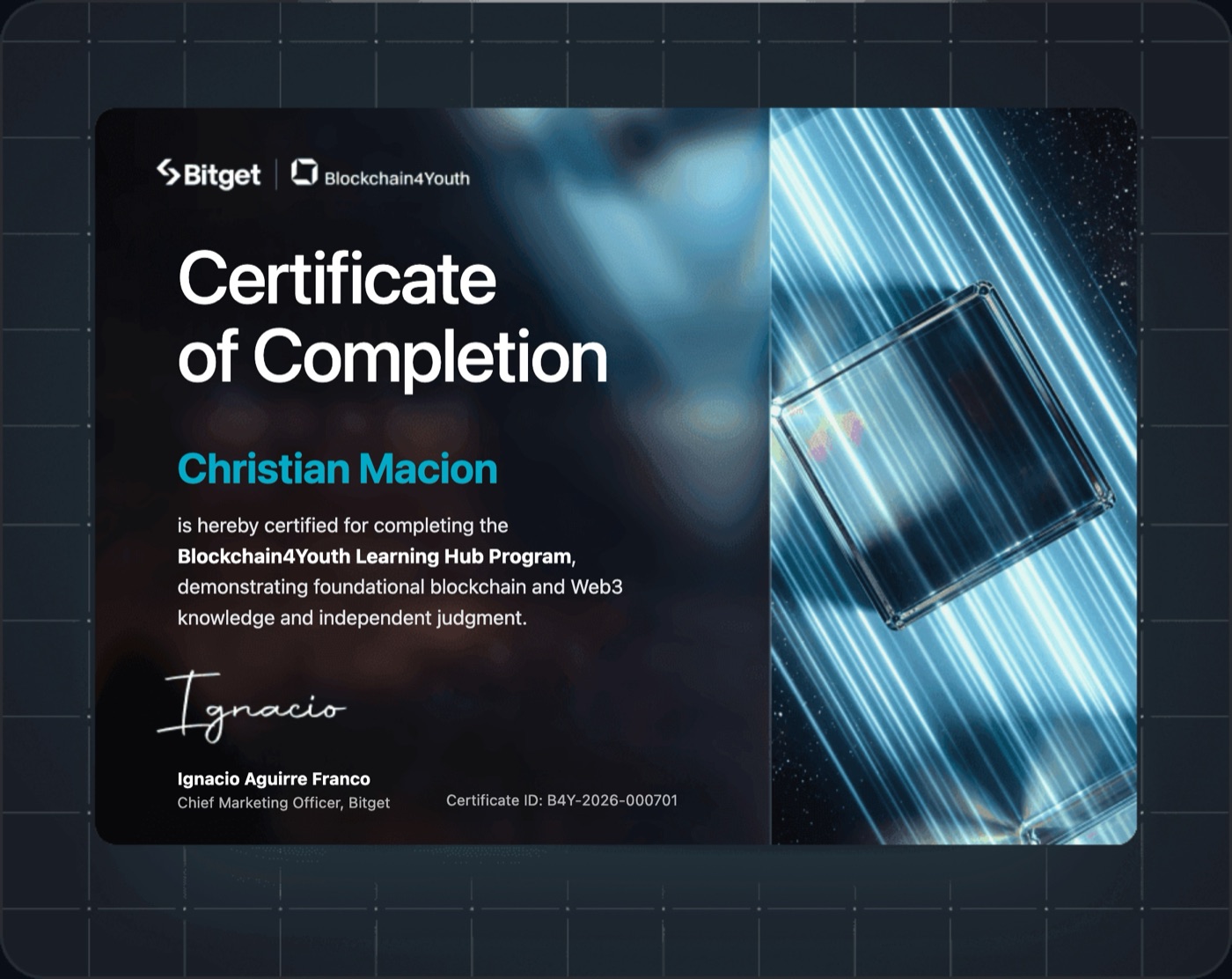
Three flagship credentials already curated on/certifications plus one standalone Tier-1 from Bitget. Each card carries the issuer, date, and the photo.
certifications
Flagship AI and data-science credentials across Tier-1 issuers (IBM, Google, Cisco, DataCamp, Ateneo de Davao).
certifications
Tier-1 finance credentials: STA flagship + Goldman / JPMorganChase brand-name work + DataCamp finance stack.
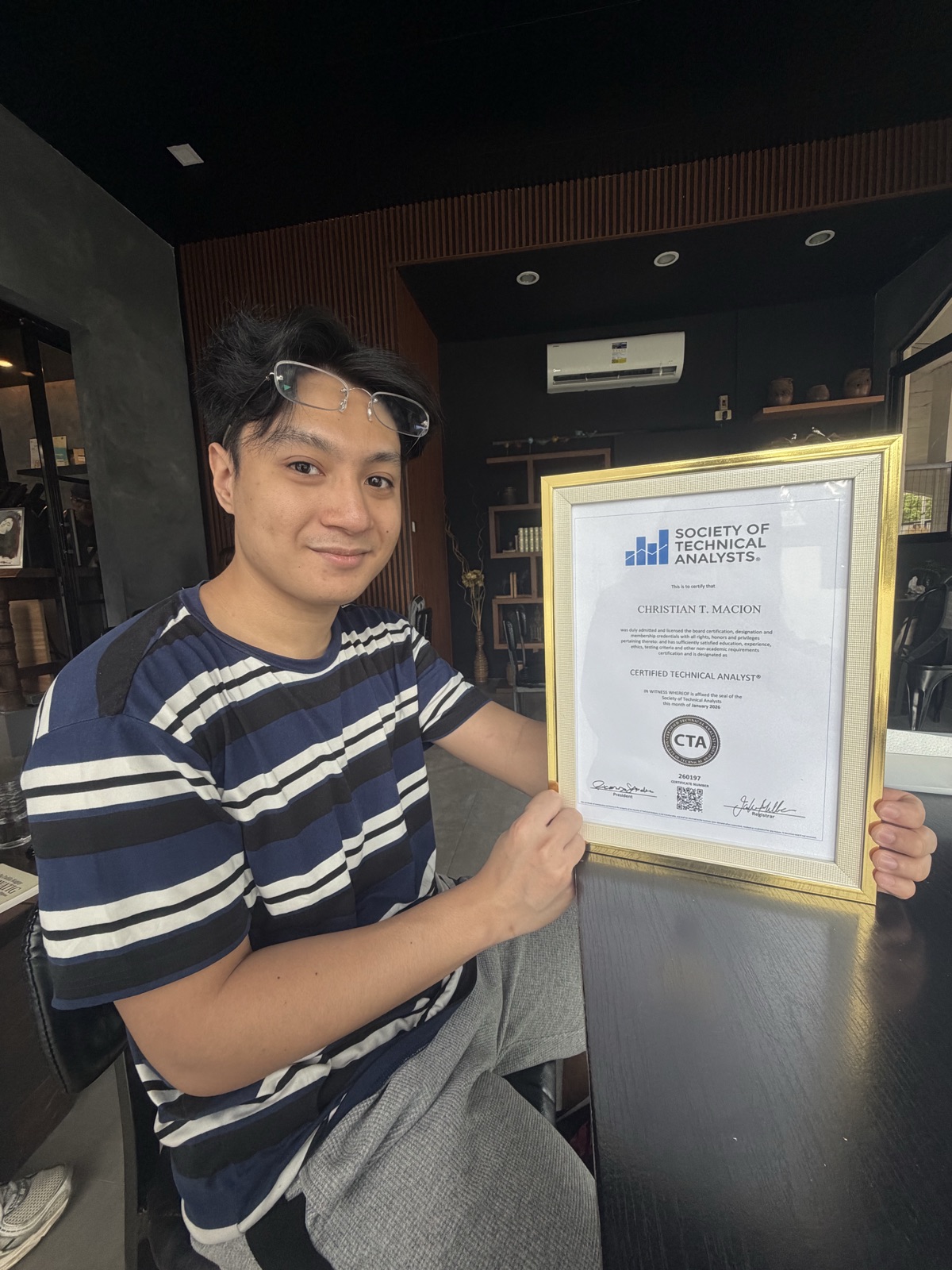
certifications
Distinguishing Tier-1 flagships that anchor a memorable profile: NASA Space Apps, Meta BIDA, university teaching, and Philippine civil-service eligibility.
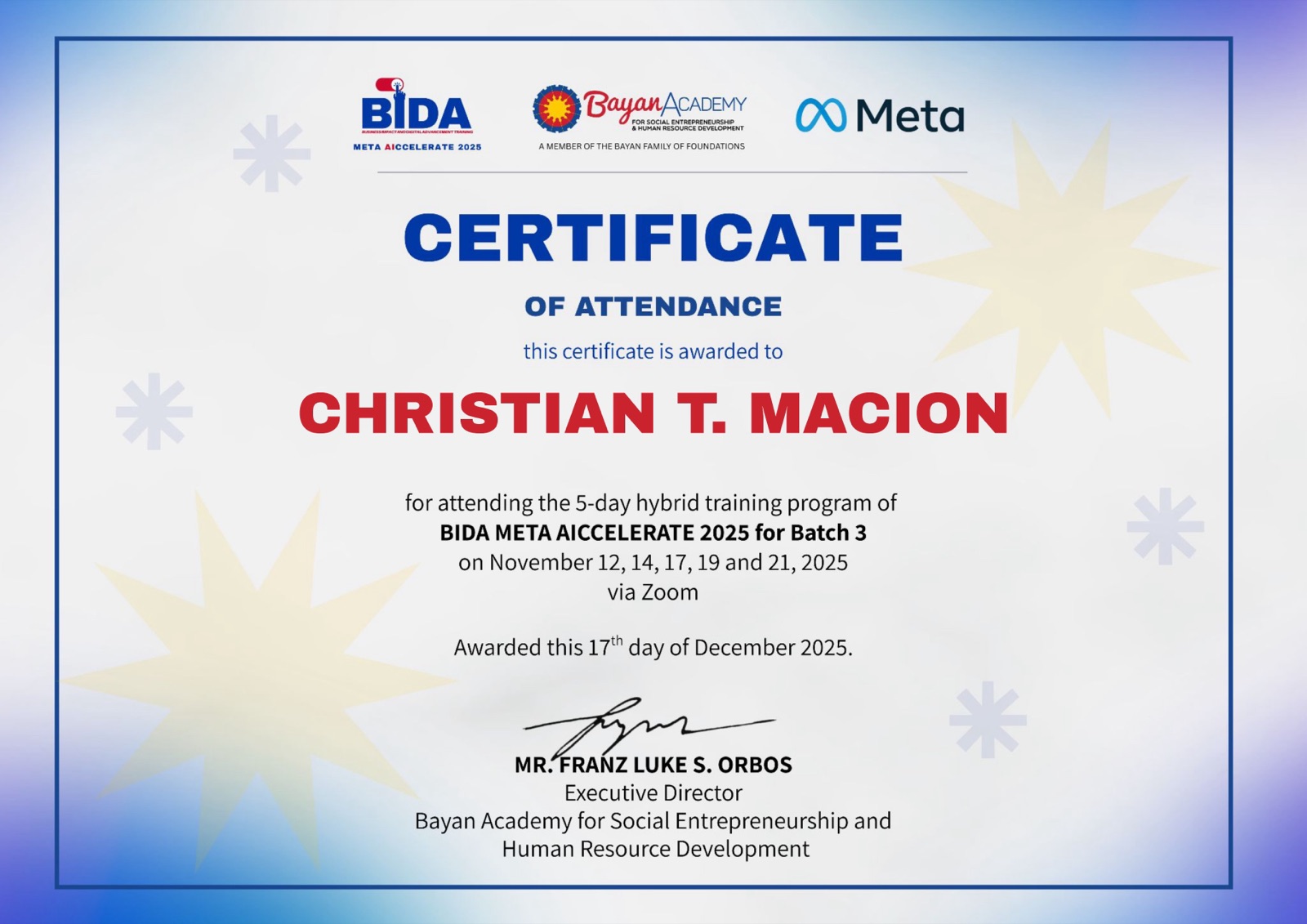
AI · Data · Technology
Bitget Blockchain4Youth · Tier-1 distinction · 2026.
P.3 · Shipped code
import.Four repositories. Each is MIT-licensed,offline-runnable, and dependency-light. Each one is a small, auditable artifact that demonstrates the eval-first methodology in code rather than prose.
IP-clean backtest tools over the Model Context Protocol. Three tools, four textbook strategies, zero market data.
        $ uv run server.py
# FastMCP server listening on stdio
{"tools":["get_ohlcv","run_backtest","compute_metrics"]}
        smoke · 262 bars returned
sma_cross sharpe=0.471 cagr=0.079 max_dd=-0.21
buy_and_hold sharpe=-0.490
PASS · deterministic from symbol seed
Citation-grounded retrieval harness over a curated corpus of 16 canonical q-fin papers. Pure-Python TF-IDF cosine, no LLM call.
        $ python -m qfin_rag "How do I correct factor significance for data mining?"

# Citations for: How do I correct ...
## Harvey (2016) — And the Cross-Section ...
*Review of Financial Studies, 2016* (relevance: 0.173)
        query → 16-paper curated corpus
top-3 by TF-IDF cosine
citation-grounded prompt template
NO network calls
Verify LLM numerical claims against deterministic fixtures. Catches the most common LLM failure mode — wrong numbers — in under one second.
        $ python -m eval_harness
[FAIL] btc_2024_sma_cross_20_50 / sharpe: claimed=5.0,
       truth=0.4707, diff=4.5293 > tol 0.05
=== summary ===
  5/10 passed (50.0%)
        fixtures computed deterministically from seeded backtest
tolerances per metric (Sharpe atol=0.05, CAGR=0.02)
per-claim reason + diff vs tolerance
exit code = number of failed claims
Slop-evaluation gate exposed as an MCP tool. Tools / Resources / Prompts — 20/20 conformance, 100% round-trip parity.
        $ uv run eval_mcp_server.py
# MCP server with the slop-evaluation gate
{"primitives":["tools","resources","prompts"],
 "tools":["evaluate_text","score_metrics","emit_report"]}
        20/20 conformance cases pass
round-trip parity across all 3 primitives
Tools · Resources · Prompts all live
PASS · slop score reproducible per call
P.4 · Research artifacts
Compact list rendering (AQR-Insights style). Each row links to the project or solution detail page; metrics come from the project frontmatter, not invented.
Best-of-160 BTC rule: IS Sharpe 1.14 is only 1.24× the pure-noise expectation — DSR = 0.70 (fail).
IS Sharpe 0.91 → OOS −0.03 — an honest decay; bootstrap CI straddles zero.
Vol-targeting lifts Sharpe 0.27 → 0.39 and halves max DD (−62% → −30%).
Implied > realized 85% of 36 yrs; predicts returns, Newey-West t = +6.5.
ADF −2.11 (not cointegrated), half-life 208 d — the fade loses, as the test predicts.
Funding +11.9% annualized premium; fade IS 1.11 → OOS −0.05 (decayed post-2023).
Vol-managed exposure: Sharpe 0.64 → 0.67, max DD −58% → −42%.
High-turnover signal wins gross (0.20 > 0.13) but loses net of cost — break-even 20 bps.
A leak inflates Sharpe 0.59 → 5.07; the shift test exposes it as 88% phantom.
RAG service that proves its own retrieval — recall@3 = 0.886, MRR@3 = 0.805 with offline stdlib TF-IDF retriever.
ReAct-style tool-calling agent with OTel traces, fault injection, and 100% tool/arg correctness.
LLM-as-judge pipeline validated against human raters — Cohen's κ = 0.58 with bootstrap CI and position-bias measured.
MCP server exposing the slop-evaluation gate over Tools, Resources, and Prompts — 20/20 conformance, 100% round-trip parity.
Reflection-loop agent — mean SLOP 127.5 → 14.0 across drafts, 3/4 improved, 1/4 honest no-progress halt.
13-metric literature-grounded AI-output quality gate — drove a real draft from HEAVY (81) to CLEAN (3).
A small systematic-trading desk needed an AI workflow that could keep pace with the research pipeline *without* shipping hallucinated or unverifiable analysis. The naive path — a single agent with one prompt — produced plausible but unfalsifiable outputs. The desk needed something closer to a research organization than a chatbot.
An operator-led venture incubation arm needed a repeatable way to triage, brief, and ledger new business ideas — without one human bottleneck, and without the agent that proposes a decision being the same one that approves it.
A high-volume editorial workflow was generating content with a measurable "slop index" — generic, templated, easily-detected text. Quality gate was after-the-fact and manual. Production scaled faster than the editorial team could review.
Most online quant research demos are not reproducible: closed datasets, undisclosed parameters, un-reported multiple-testing bias, and no OOS discipline. A hiring-grade research portfolio needs every one of those addressed explicitly.
Naive Sharpe ratios ignore the search effort — if you try 100 variants of an idea, the best-looking one will overstate the true edge. The desk needed this multiple-testing correction built into the validation pipeline, not stapled on at the end.
LLM eval harnesses live in code or in spreadsheets — neither is a clean integration target for multi-agent pipelines. A multi-agent system needs the eval gates exposed as **tools**, not as Python imports.
Crypto perps run funding payments every 8h. A naive long-short book ignores funding carry and bleeds slowly when the spread is inverted. A working stat-arb needs the funding cost added back to P&L *before* sizing.
Backtests that ignore transaction costs, slippage, and latency are the most common source of overfit research. A backtest engine needs all three treated as first-class inputs, not as after-the-fact deductions.
Look-ahead bias is silent: a backtest that uses future data looks great until you deploy it. A serious research portfolio needs an **explicit audit suite** — a checklist of failure modes with mechanical tests.
The Philippines has limited access to rigorous CTA-grade technical analysis training. Most curriculum is either imported (US/UK, expensive) or shallow (TA-by-rote). There's a gap for affordable, rigorous, evidence-based technical analysis education.
P.5 · Public track record
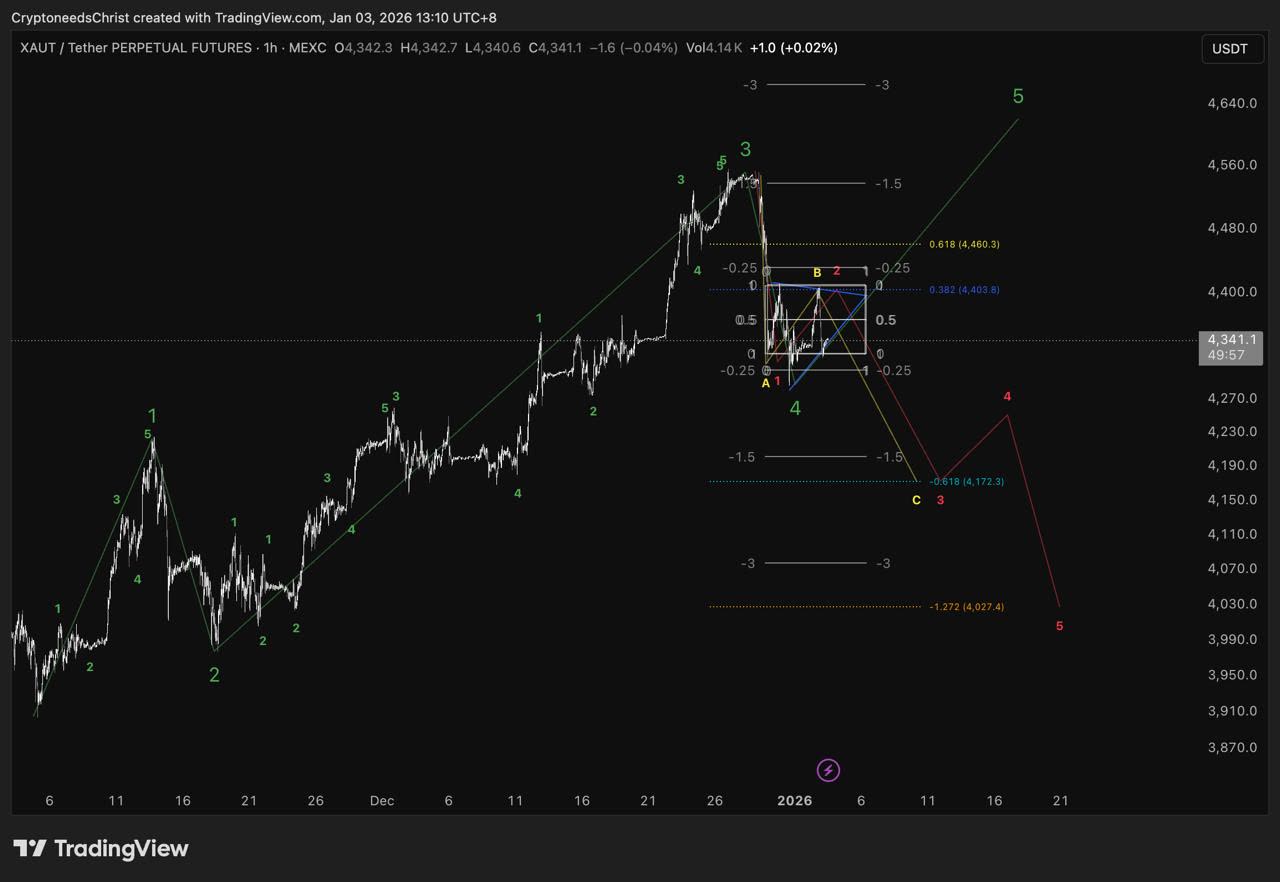
Two public lectures for USeP EGE 313, one public TradingView chart, and three Atom feeds (portfolio updates · project updates · solution updates).
P.6 · What's not here
What's not here: photos of the 19V Capital office. Screenshots of proprietary strategy outputs. Calendar entries with client names. The 19V Capital role is a closed past contract (03/2026 – 06/2026), and everything on this page is public-data or self-owned. If the proof you need isn't on this page, email me — if it's public, I'll send it within 24 hours.
Email me with the proof you need. If it's public, NDA-clean, and I have it on disk, I'll send it within 24 hours.